
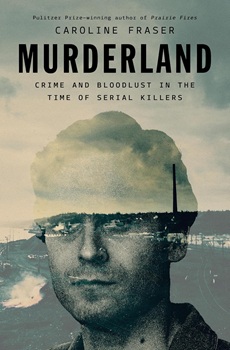
Murderland: Crime and Bloodlust in the Time of Serial Killers by Caroline Fraser
Set aside your preconceived notions about how a true-crime book should read. This one is wild. Comprehensive in history and background material, “Murderland” never goes off the rails, but it does take some side trips to unexpected destinations. Don’t jump off the train, though; it’s worth the ride.
Caroline Fraser’s book about the serial killers that haunted Washington, Oregon, Idaho and beyond in the 1970s and 1980s is, in her own words, a “crazy wall” of connections. Its chapters look deeply into the man-made environment surrounding killers in this region. Fraser compares “Murderland” to the type of wall map that police or conspiracy-minded people might poke pins into and string together to discover hidden patterns.
“Play along at home,” she wrote. “[C]onnect the clues with string or yarn until the whole thing resembles a graph of sheer lunacy, a visual eruption of obsession.”
Fraser sets the stage with a lecture on the Olympic-Wallowa Lineament, or OWL, a geological structure that she describes as something akin to the San Andreas fault line; cutting a diagonal line from Cape Flattery in the northwest through Elliott Bay, Mercer Island and Issaquah to Northeast Oregon. The implied message is there’s something about this place’s environment — natural and manmade — that might be complicit in the cultivation of its serial killers.
The next chapter finds Fraser talking about floating bridges, specifically the Interstate 90 Lake Washington floating bridge that leads to Mercer Island, where the author grew up. They lead to anecdotes of growing up on Mercer Island in the 1960s and 1970s as the daughter of a devout Christian Scientist father. Fraser reveals much more of that experience in her 1999 book, “God’s Perfect Child: Living and Dying in the Christian Science Church.”
In “Murderland,” this strict upbringing ties in with the rest of the pollution and environmental abnormalities that affected so many lives in the Pacific Northwest: “My problem is my father. He gets angry. He has high expectations and a hot temper. Sometimes when he loses it, he has a look in his eyes, a blank look.”
Fraser delves into Ted Bundy’s origin story as the unwanted son of a single mother who eventually brings him to Tacoma, where the legendary Rockefeller and Guggenheim families had fought for the ownership of the American Smelting and Refining Company (ASARCO) in the 1890s and 1900s.
Bundy, who confessed to killing at least 30 women and young girls, spent much of his childhood in Tacoma across the bay from the huge ASARCO smelter that, in 1953, when Bundy was 7 years old, pumped out “six hundred and thirty tons of arsenic and a couple hundred tons of lead” into the Tacoma air. It is “one of the largest sources of arsenic emissions in the world.”
The book goes into great detail about the poisonous output of smelters in Tacoma and elsewhere. Lead is sweet-tasting, we learn. It interacts with the calcium in the bones of growing children. In Tacoma, it has been in the air, on the lawns, in the food.
“Lead is a vampire,” Fraser wrote. “Invite it in and it will drink your blood and live forever.”
While the focus of “Murderland” is on the Pacific Northwest, we read about other serial killers around the country. This book is not a scientific study, but Fraser has done a significant amount of research, and the result is a thought-provoking story. Her writing is compelling, and the connections she makes are not easily dismissed. It’s clear she lived through this dark time and place — and she was paying attention. Her book is a cautionary tale written on a huge map with pins and yarn.
Neil McKay is the online experience coordinator for Whatcom County Library System, wcls.org.
(Originally published in Cascadia Daily News, Friday, May 8, 2026.)