
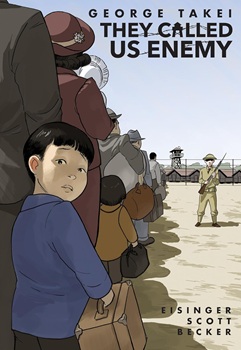
They Called Us Enemy by George Takei
OG “Star Trek” fans know George Takei for his classic role as Sulu, helmsman of the USS Enterprise. Others know him as an activist for gay rights and the rights of immigrants. Born to Japanese-American parents, Takei and his family were forced to live in the Tule Lake Segregation Center in rural Northern California during World War II. His graphic novel memoir, “They Called Us Enemy,” recounts his experience.
Takei was only 5 years old when soldiers with bayonets knocked on the door of his family’s Los Angeles home and sent them across the country under Executive Order 9066. Signed by President Franklin Roosevelt, the order was issued a mere two months after the bombing of Pearl Harbor and Roosevelt’s famous “date which will live in infamy” speech. It designated military areas along the West Coast from which any or all persons were excluded.
In practical terms, the order resulted in the forced removal of 125,000 people, two-thirds of whom were U.S. citizens, to prison camps in the interior of the U.S. The majority affected were people of Asian descent. Families lost their homes, their livelihoods, their belongings and three or more years of their lives in the name of national security.
For Takei, it was a bewildering and indelible part of his childhood. His parents modeled resilience. His mom smuggled in a sewing machine and made curtains for their single-room shack and clothing for her three children; his father became a leader and go-between as a Block Manager. Takei and his brother had snowball fights and enjoyed an occasional jeep ride. They also suffered mightily with cramped and unhygienic conditions, daily indignities, systemic racism and stress.
Takei’s memoir doesn’t shrink from difficult topics: his family’s poverty upon release from Tule Lake, the racism perpetrated by classmates and teachers, the sadness of receiving news from extended family back in Japan. However, he doesn’t dwell on negativity. He recounts his education at UCLA and his first forays into acting, the times he met Martin Luther King Jr. and Eleanor Roosevelt, and his good fortune to land the part of Sulu in “Star Trek.” He acknowledges the role gave him a springboard to a larger audience and a platform to share his views on a variety of social issues.
Takei’s book is co-written by Justin Eisinger and Steven Scott, who keep the text brief and simple. The art, by Harmony Becker, is expressive and easy to follow. The graphic format allows readers to absorb a complex and emotional story in an unintimidating manner, accessible to all.
This month, Whatcom County Library System joins Bellingham Public Library and libraries all along the Pacific Coast in the first-ever “One Book, One Coast” program coordinated by the Los Angeles County Library to celebrate Asian American Native Hawaiian Pacific Islander Month. “They Called Us Enemy” is the inaugural title. The library has print copies and unlimited access to the eBook version.
Visit wcls.org/onebookonecoast for details and information about supporting events, including “Different Paths: Two Stories of WWII Japanese American Incarceration,” at 6–7:30 p.m. Thursday, May 21 at the Lynden Library. The public is invited to watch a free livestream presentation by Takei from 2–4 p.m. Sunday, May 31 at the Ferndale Library. Viewers may choose to watch the livestream from home by registering for the event online.
Christine Perkins is executive director of the Whatcom County Library System, wcls.org.
(Originally published in Cascadia Daily News, Tuesday, May 12, 2026.)