
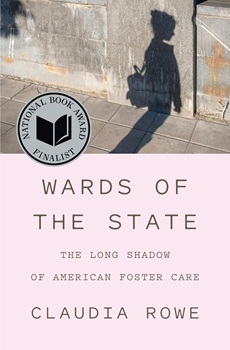
Wards of the State: The Long Shadow of American Foster Care by Claudia Rowe
As a journalist for the Seattle Times, The New York Times and Mother Jones, Claudia Rowe is no stranger to reporting on the horrible things that can happen to children.
Her story about Latino youth gang activity in Grant County, Washington, was nominated for a Pulitzer Prize. So in 2016, when she heard about the case of a 16-year-old Seattle girl on trial for murdering a 21-year-old gangster, it wasn’t the fact that Maryanne Atkins was accused of pulling the trigger that caught her attention: It was her defense.
According to her public defender, the government was as culpable in the murder charges as Atkins herself. Years of neglect and abuse left Atkins with staggering PTSD. The child welfare system had failed to protect her from sex trafficking and rape. In and out of foster care, Atkins suffered from starvation, cruelty and loss.
Atkins pled guilty, hoping her age and extenuating circumstances would shorten the length of her sentence. The judge gave her 19 years; longer than the time she had been alive. In his ruling, Judge Ferguson stated, “The court is hesitant to indict, wholesale, the foster care system. But opportunities were missed.”
This incident struck a chord with Rowe, who continued to report on juvenile crime and started to notice patterns. Among them: An estimated one-fifth of all prison inmates nationally are former foster children. Rowe wondered whether children whose family circumstances necessitated foster care were predisposed to commit crimes, or if there was something about the foster care system itself leading to these unfortunate outcomes.
In 2021, Rowe began conducting interviews with numerous people associated with the foster care system. In “Wards of the State: The Long Shadow of American Foster Care,” she focuses on six of them, using their stories to identify when and how the system failed them.
In addition to Atkins, Rowe meets with Arthur Longworth, convicted of murder at age 16, right after he was cut from Washington’s child welfare system. Sentenced to life without possibility of parole, Longworth is now an advocate for foster care reform. According to Longworth, “The reality is that foster care trained kids not for productive adult lives, but for success in carceral settings.”
Rowe’s other interviewees include Sixto Cancel, abandoned by his adoptive mother as a boy, who nevertheless managed to establish a philanthropy aimed at supporting foster youth. There’s Monique Thompson, who cycled through 10 foster homes after her stepfather sexually assaulted her.
Rowe also introduces readers to the social workers, law enforcement officers, legal system staff and legislators who are part of the foster care ecosystem. She relates the story of Judge Gray, a pioneering reformer who overhauled the foster care system in New Orleans, only to have it regress upon her retirement in 2020.
According to the Annie E. Casey Foundation’s Kids Count Data Center, there are more than 5,000 foster children in Washington state as of 2024. Intended to provide “safe, temporary living arrangements and support services for children who have been removed from their families due to maltreatment, lack of safety or inadequate care.”
In an ideal world, the foster care system can serve a critical role in protecting children and stabilizing their lives until they can be safely reunified with family. Rowe paints a bleak picture of the system as it exists currently, but she points to renewed interest in kinship care — the care of children by relatives and others — and in focusing on preventing family stressors that send children to foster care in the first place, as promising developments.
Rowe is clear to state that foster care can be an essential tool for helping children whose home lives are in crisis, noting that in some cases it may be the best option. Also implied if not explicitly stated, is the recognition that there are many caring and dedicated people — social workers, foster parents and others — who are doing important work within the existing system to help children in any way possible.
The Washington state Department of Children, Youth & Families promotes opportunities for foster parenting and kinship care, including a phone number for inquiries (888-KIDS-414). Locally, Skookum Kids is a 501(c)(3) nonprofit that “exists to mobilize communities to create a healthy foster care system.”
Christine Perkins is executive director of the Whatcom County Library System, wcls.org.
(Originally published in Cascadia Daily News, Friday, April 24, 2026.)