
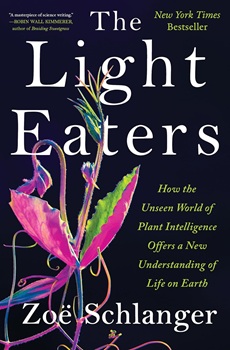
The Light Eaters: How the Unseen World of Plant Intelligence Offers a New Understanding of Life on Earth by Zoë Schlanger
In “The Light Eaters: How the Unseen World of Plant Intelligence Offers a New Understanding of Life on Earth,” author Zoë Schlanger challenges our narrow preconceptions of consciousness. By tracing the evolution of animal rights, Schlanger suggests we are nearing a similar paradigm shift for plant life and leaves the reader to ponder what our ethical duty is in a world where plants might possess sentience.
Under the influence of a Kantian worldview, animal vivisections were practiced throughout the 19th century. However, our scientific and ethical understanding of animals changed.
Animal rights and protection grew over the course of the 20th century, thanks to the advocacy of animal welfare societies, the work of legislatures, and a growth in scientific studies to bolster our understanding of the inner lives of animals.
By 2012 a group of scientists gathered at Cambridge University to declare that mammals, birds and octopuses possess consciousness. These advances had moral and ethical implications for how we treat and coexist with other sentient beings.
This example of a paradigm shift in our understanding of animal consciousness lays the groundwork for Schlanger’s thesis.
Drawing on Thomas Kuhn’s theory of scientific revolutions, Schlanger argues that the current consensus on plant life is under siege. She spends the bulk of the book presenting compelling evidence: Science shows that plants communicate, retain memories, react to pain and even use animals as tools.
While their physiology lacks a mammalian nervous system, Schlanger provokes the reader to ask: Should a lack of neurological architecture automatically disprove cognition?
“The Light Eaters” is not a revolutionary treatise for plant intelligence, but rather a thought-provoking look at the history of scientific advancement that makes the case for a forthcoming shift in the ethics and morality of how humans engage with sentient lives different from our own.
“The Light Eaters” should appeal to readers of popular science, plant science or anyone interested in learning something new about the hidden lives of plants.
Visit wcls.org to find “The Light Eaters” and other similarly themed stories.
“The Light Eaters” is the April selection for the Books & Bites book group. Join Books & Bites at 1 p.m. Friday, April 17, at Blaine Public Library for community and lively conversation.
Jonathan Jakobitz is an avid reader and the branch manager of Blaine Public Library.
(Originally published in The Northern Light, Wednesday, April 1, 2026.)