
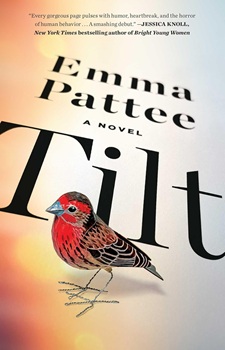
Tilt by Emma Pattee
As our neighbors in Sumas and Everson can attest, nature is a powerful force that can completely upend lives: destroying homes, threatening personal safety and straining mental health to the limit. Debut author Emma Pattee imagines life after a major earthquake — when “the Big One” hits Portland — something that is predicted to happen across the Cascadia Subduction Zone within the next 50 years.
In “Tilt,” Annie is nine months pregnant and having a minor meltdown in a Portland IKEA while crib-shopping. Annie’s not even sure she should be splurging on the purchase, since her aspiring actor husband, Dom, just lost out on another audition, and his coffee shop job doesn’t really cut it. Then the floor buckles, shelving units crunch and twist, and hundreds of pounds of boxes full of unassembled particle board furniture crash around her. It’s dark, people are screaming and Annie is trapped.
A hand finds Annie and pulls her free. Ignoring the shrieks and moans of others in her panic, Annie struggles out of the building, purse and cellphone lost in the rubble. Her one focus: get to Dom at his workplace. She sets off walking, as fast as a terrified, banged-up, ready-to-pop mama can go, propelled by adrenaline and fear.
Pattee keeps the pace taut and Annie’s interior dialogue flowing as she narrates the chaos to her future child, Bean. She’s desperately thirsty, horrified by the carnage she sees on the streets, sympathetic to the looters and completely irrational. Bridges and buildings have been reduced to snarled rebar and concrete chunks. People are acting like feral animals. Doggedly, she keeps moving forward, following some primal need to connect with her husband even as she ponders the various ways their marriage has faltered over the years.
Pattee jumps back and forth from the present moment to earlier ones in Annie’s life: recounting the first time she saw Dom on stage; her once-promising, now-stalled playwriting career; her mother’s death from COVID; and her apprehensions about looming motherhood.
Over the course of 24 hours, Annie traces a path across Portland, dodges aftershocks, draws upon deep reserves and superhuman strength, and ruminates on her life and the future life of her unborn child. It’s a tense, thought-provoking tour de force. Annie is a highly relatable “everywoman,” and her choices and response to the disaster may be the perfect thing to spur people to consider what they might do in a similar situation.
Pattee is a climate journalist who has written for publications such as The Washington Post, WIRED and The Guardian. In an interview with Indie Next, she said she wanted to keep her novel “as close to a nonfiction depiction of an earthquake that hasn’t happened yet as it could possibly be.”
Making sure the science was accurate was important to her, but writing a fictional story allowed her to imagine what could happen more fully. (For those who want to dig deeper into the facts, she recommends “Full Rip 9.0: the Next Big Earthquake in the Pacific Northwest” by Sandi Doughton. See also “The Pacific Northwest Disaster Guide” by Henry Latourette Miller, an illustrated survival handbook.)
Whatcom County Library System is offering three events with disaster preparedness expert Jackie Kloosterboer at county libraries in March, April and May. Register for the free class “From Panic to Prepared: A Practical Guide to Readiness” at wcls.org/events (search for “prepared”).
Christine Perkins is executive director of the Whatcom County Library System, wcls.org.
(Originally published in Cascadia Daily News, Sunday, January 18, 2026.)