
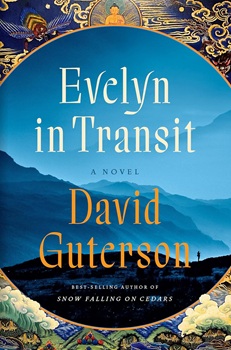
Evelyn in Transit by David Guterson
Bainbridge Island author David Guterson — best known for his PEN/Faulkner award-winning debut novel, “Snow Falling on Cedars” — draws on his knowledge of and experiences with Tibetan Buddhism in his recently published novel, “Evelyn in Transit.”
In the novel’s opening chapters, Evelyn, a young girl climbing trees in Evansville, Indiana, and Tsering, a young boy in Tibet playing on a pile of yak hides, both have a jolting sensation of waking from a dream with the thought: “I’m alive. I’m separate from everything else.” These existential epiphanies on opposite sides of the globe launch Evelyn and Tsering onto parallel paths as spiritual seekers.
Evelyn is quirky, eccentric and often at odds with small-town sensibilities and her Catholic upbringing. Large for her age, awkward and ungainly, she is frequently the brunt of teasing by her peers.
Finding the Catholic Church’s answers to her metaphysical questions unsatisfactory, at 18, Evelyn hits the road in search of an authentic life. Restless, hitchhiking west, she finds temporary work as an apple picker, stays briefly with a group of hippies picking salal, and takes a position in an eldercare facility.
When she hears a Buddhist retreat center in New Mexico needs someone to haul stones up the mountainside for the building of a stupa (or sacred Buddhist monument), Evelyn signs on — intrigued by the belief that if you help build a stupa, you can reach nirvana faster. While there, besides carrying 1,000 stones up the mountain on her back, Evelyn learns about Tibetan Buddhism from Lama Lobsang.
Back on the road, Evelyn meets Scott Widera, a dope-smoking fellow seeker, at a bus stop in Truth or Consequences, New Mexico. They wander north to Alaska, where Scott abandons her just days before Evelyn realizes she is pregnant.
Meanwhile, alternating chapters follow the life of Tsering, declared to be the sixth incarnation of his monastery’s late leader. The two storylines converge when a trio of lamas comes to Evelyn’s door, informing her they believe 5-year-old son, Cliff, is the seventh reincarnation of the illustrious, recently deceased Norbu Rinpoche, and encouraging her to allow Cliff to return with them to Tibet and commit to a monastic life.
Guterson became interested in Buddhism at an early age through contact with a childhood friend whose family had ties to the Sakya Monastery in Seattle. He later studied Tibetan language and history while at UW. “Evelyn in Transit” is Guterson’s first book dealing explicitly with Buddhism.
The plot piece about Evelyn’s son Cliff, believed to be the reincarnation of a Tibetan lama, is loosely based on the true story of Seattleite Carolyn Massey. Her Sonam Wangdu was, at 4 years old, formally recognized as the fourth incarnation of a Tibetan lama. Carolyn sent Sonam to Nepal where he underwent monastic training. Like Evelyn, Carolyn also grew up Catholic in a rural Indiana town and spent time in Alaska. This little-known bit of Seattle history adds a fascinating local biographical element to this story.
While some readers may find that “Evelyn in Transit” reads more like a series of small vignettes than a typical story arc, Evelyn’s authenticity and desire to live a meaningful life make her an engaging, memorable character who simply desires “to live the right way, if that wasn’t asking too much from life.”
Lisa Gresham is the collection services manager for the Whatcom County Library System, wcls.org.
(Originally published in Cascadia Daily News, Friday, February 20, 2026.)